
By Coy Du, CEO of Makefay
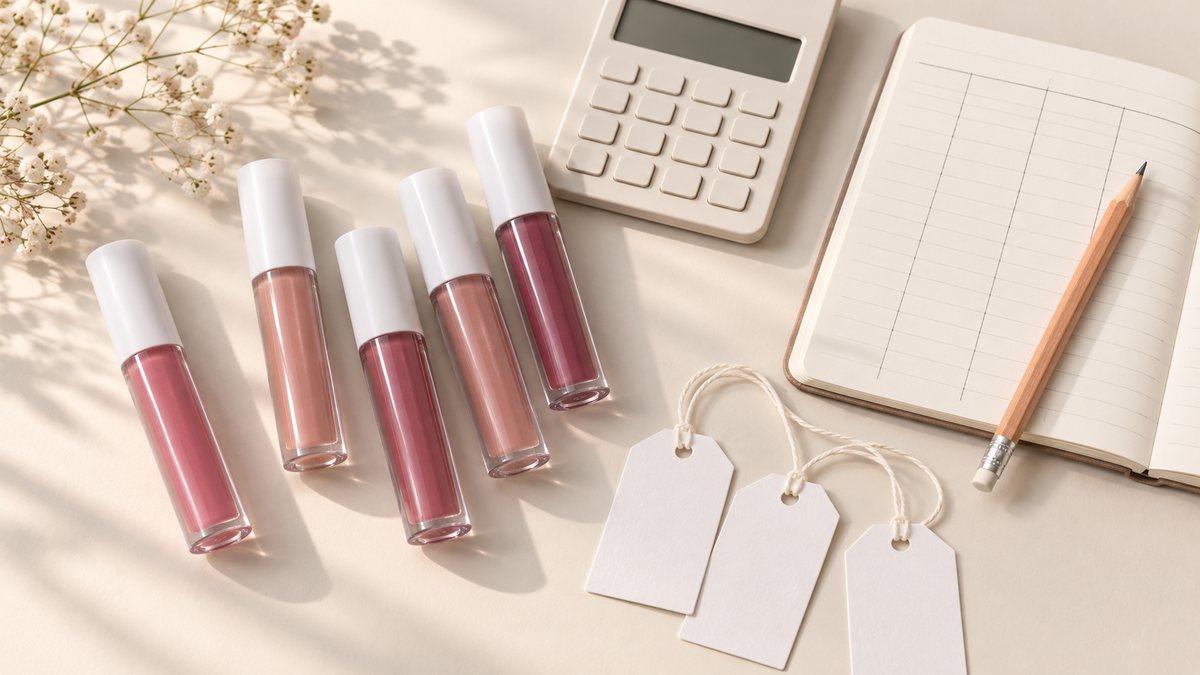
Short answer: Price private label makeup from the landed cost, not from the factory unit price. Landed cost per piece = unit price + logo and packaging + shipping + import duties and taxes + a share of one-off costs such as sampling. Then choose a retail price that leaves room for selling fees, delivery to the customer and marketing. Many small brands set retail at about 4 to 6 times the landed cost and check the result against competitors.
All figures in this guide are illustrative examples to show the method. They are not Makefay prices. Your real numbers come from your quote, your shipping method and your country’s duty and tax rules.
What goes into the landed cost per piece?
| Cost line | Who sets it | Per piece or one-off | Note |
|---|---|---|---|
| Unit price | Supplier quote | Per piece | Depends on product, quantity and pack |
| Logo printing | Supplier quote | Per piece or per order | Depends on the print method |
| Box | Supplier quote | Per piece | Custom printed boxes start at 500 pcs |
| Samples and custom sampling | Supplier | One-off | Stock samples are free, buyer pays shipping; custom sampling is USD 150 |
| International shipping | Carrier or forwarder | Per shipment | Express, air or sea; divide by the number of pieces |
| Import duties and taxes | Your customs authority | Per shipment | Not included in the quote; you declare and pay them |
| Certificates, tests, notifications | Depends on the market | One-off | Confirmed with your quote |
How do you calculate it? A worked example
Example only: 100 lip glosses with a logo, shipped by express.
| Line | Example figure | Per piece |
|---|---|---|
| Unit price with logo | USD 160.00 for 100 pcs | USD 1.60 |
| International shipping | USD 40.00 | USD 0.40 |
| Import duties and taxes | USD 20.00 | USD 0.20 |
| Landed cost | USD 220.00 | USD 2.20 |
How do you get from landed cost to a retail price?
Multiply the landed cost, then check the result against what similar products sell for. Gross margin = (retail price − landed cost) ÷ retail price.
| Multiple of landed cost | Retail price | Gross margin | Typical use |
|---|---|---|---|
| 3× | USD 6.60 | 67% | Wholesale-heavy or price-led brands |
| 4× | USD 8.80 | 75% | Marketplaces with strong price competition |
| 5× | USD 11.00 | 80% | Own online store |
| 6× | USD 13.20 | 83% | Brands with paid advertising or influencer costs |
What is left after selling costs?
Gross margin is not profit. Continue the example with a retail price of USD 12.00.
| Line | Example figure | Share of retail price |
|---|---|---|
| Retail price | USD 12.00 | 100% |
| Landed cost | − USD 2.20 | 18% |
| Platform and payment fees (example 15%) | − USD 1.80 | 15% |
| Packing and delivery to the customer | − USD 1.50 | 12% |
| Marketing per order | − USD 3.00 | 25% |
| Left per piece | USD 3.50 | 29% |
If the amount left is too small, change one of four things: the retail price, the quantity, the shipping method or the marketing cost. Do not start by cutting the product quality.
How does order quantity change the cost per piece?
One-off costs are divided by the number of pieces. The same USD 150 custom sampling fee looks very different at 50 and at 1,000 pieces.
| Order quantity | Sampling fee per piece (USD 150 ÷ quantity) | What else changes |
|---|---|---|
| 50 pcs | USD 3.00 | Stock box only; express shipping is usual |
| 200 pcs | USD 0.75 | Shipping per piece falls |
| 500 pcs | USD 0.30 | Custom printed box becomes possible |
| 1,000 pcs | USD 0.15 | Air or sea freight may cost less per piece than express |
This is why a first order of 50 pieces is a test of demand, not a way to reach the lowest cost. See growing from 50 to 5,000 pieces.
How should you set wholesale and bundle prices?
| Price type | Common rule | Example at USD 12.00 retail | Check |
|---|---|---|---|
| Wholesale | About 50% of retail | USD 6.00 | Margin over landed cost: 63% |
| Bundle of 3 | 10–20% off the single price | USD 30.60 at 15% off | One delivery cost instead of three |
| Launch discount | Time-limited | — | Set the full price first; discount from it |
Mistakes to avoid
| Mistake | Why it costs you | Do this instead |
|---|---|---|
| Pricing from the unit price only | Shipping, duties and fees are missing | Price from the landed cost |
| Forgetting duties and taxes | They are not in the supplier quote | Ask your customs broker or check the official tariff before ordering |
| Copying a competitor’s price | Their cost and volume differ from yours | Use competitors as a check, not as the method |
| Leaving no room for discounts or wholesale | Every promotion becomes a loss | Test the wholesale price before you publish the retail price |
| Spreading 50 pcs across too many products | Shipping and one-off costs per piece rise | Concentrate the first order |
| Ignoring breakage and returns | A few pieces per order cannot be sold | Add a small allowance to the landed cost |
FAQ
What is a good profit margin for private label makeup?
There is no single figure. As an illustration, a retail price of 4 to 6 times the landed cost gives a gross margin of 75% to 83% before selling fees, delivery and marketing. What matters is what is left after those costs.
What is landed cost?
The full cost of getting one piece to you: unit price, logo and packaging, international shipping, import duties and taxes, and a share of one-off costs such as sampling.
Does the supplier quote include duties and taxes?
No. Our prices exclude import duties and taxes. The buyer declares and pays them in the destination country.
Is a 50-piece order profitable?
It can be, but its main purpose is to test demand. One-off costs and express shipping are divided by only 50 pieces, so the cost per piece is higher than on a larger order.
How do I get real numbers for my product?
Send an inquiry with the product, quantity, logo method, box and destination country. The quote gives you the unit price; your forwarder or carrier gives you the shipping cost.
Should I price lower to win my first customers?
Set the full price first, then use a time-limited launch discount. Raising a price later is harder than ending a discount.
Next: read what a private label makeup line costs to start and importing makeup from China.
About the author: Coy Du is the CEO of Shenzhen Makefay Cosmetics Co., Ltd., a private label cosmetics company in Shenzhen, China, founded in 2014. About Makefay.